The gun metal plate has always been a very popular finish with the pen kits. They offer a great alternative to the gold and chrome finishes.
The gun metal plating in the European pen kits would also make a good alternative for the cartridge rifle bullet pens that is becoming popular in the market place.
Mix the Camo pen blanks with the gun metal finish and as you can see above, you end up with a pen which is very suited to people who deal with fire-arms or hunting.
We have also brought into our range the Camo pen blanks. You can now get them in Australia for an extremely attractive price of just $2.50 / blank.
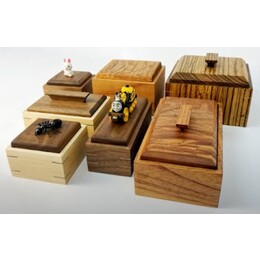
I have been making these boxes for quite a few years now. They are very popular in the wood galleries and I have process of making them down pat.
The editor of the Australian Wood Review saw a few of my boxes at Bungendore Wood Works Gallery and asked if I would like to write a small article on how to make to boxes.
I was more than happy to share my knowledge with other woodies because this was how I learned my woodworking as well – caring is sharing.
I was just getting ready for a batch of 50 boxes for a corporate order so I took some notes and photographs to document how I made these boxes.
After I complete the series of videos on how to make and assemble the pen kits, I will move onto make a series of videos on how to make these pen boxes. There are few more steps that are needed to make these boxes than making pens, but they are easy to make once you get your jig made and set up.
We brought in the new Baron II Rollerballs with the new 12 facet pen grips because we thought they were a great improvement over the old 3 facet Barons. Numerous customer feedback has proven this to be the case. A natural follow on from the success of the Rollerballs is to introduce a Fountain pen version.
The old Barons had a 3 facet pen grip for the rollerballs and a round pen grip for the fountain pen versions. Pen makers use to be frustrated with the fact that the two versions didn’t have the same grip. The 2 pens simply gave out different appearances when shown side by side. Pen makers who tried to sell the two pens together had a difficult time convincing the customers that they were a match pair.
I know it has been a while, we ordered the pens from the factory back in February, but the shipment was held up by the fountain nib manufacturers in Germany and the also the piston cartridge converters.
The nib has a very smooth action, an absolute delight to write with. The piston cartridge converters are also a highlight. The converters, rather being of plastic appearance, has been plated with chrome or gold to match the plating of the pens. You will really see a difference once you see them in person.
The fountain pens comes in 3 platings, upgrade gold, chrome and gold titanium. They are priced the same as the rollerballs – we are the lowest priced sellers of the Barons in Australia if not the world.
After applying the 20 thin coats of CA. I use the micromesh buffing pads to get the satin finish to bright high gloss finish.
The Micromesh pads is a great system for the final buff. These pads last a long time, I get over 50 pens for each set of pads.
I generally spend a bit more time on the 1st pad – the brown pad. This way it takes all the high spots off and smoothes all surfaces.
I use the it as a wet buff. You can see the white paste gathering on the pad, that the slurry from the CA finish.
Because I am wet sanding, after each day’s turning, I give the lathe a good clean down and seal with WD40. It just keeps the rust off the lathe and any other machinery which accidental get wet.
As a final buff after the Micromesh, I use Brass for a final cut. Then a coat of automotive wax for a final layer of protection. The wax also helps with giving a much higher level of gloss on the pen. I use a pincer action to put pressure on the towel to generate a bit of heat which will make the wax go hard.
You can purchase the micromesh pads on the following link – Micromesh pads
By popular demand, were bringing in some Camo pen blanks.
This is a Baron pen kit with the new chip Camo pen blanks. We will be selling them for only $2.50 / blank. Size will be 20mm x 20mm x 125mm.
These blanks are made in Taiwan rather than Main Land China. They are very high quality and doesn’t seem to be as brittle as the Main Land China ones.
This Chrome Baron II was turned down with the 3/4 inch roughing gouge. Sanded down with 80, 120, 180, 240, 400 grit sandpaper. It was then buffed with 800 grit Micro mesh through to 12,000 grit. Brasso was used as a final buff before a layer of automotive was applied to produce a really high shine finish.
I get asked quite often how much do you sell your pens for? and can I make money from turning pens?
My answer is often how much you get depends on what your selling and yes for sure you can make quite a bit of money from selling pens.
How much I sell my pens for is based on the current calculations. For retail prices I generally use the following calculation. 3 x price of kit + 5 x price of blank + $20 for an upmarket pen.
So for example, a Red Mallee baron rollerball pen kit in upgrade gold is priced 3 x $10 + 5 x $3 + $20 = $65. This is the minimum price I normally sell for. If it was a special piece made particularly well I would price it at about $90 and let people bargin a bit down to $75 or $80.
Some people may say that’s too low, some may say it’s to high. I would say that is probably in the middle range of what people sell for. Too low $50 for about 30 mins work is not too bad considering your working at home. Too high, well its a hand crafted 1 off piece.
Slimlines and Streamlines prices are not based on that calculation. Generally slimlines are priced between $12 – $30 depending on where and when they are sold and also what finish is put on the kits. Most people use a friction polish like Shellawax, Glow or just plain bee’s wax.
I use ordinary paper towels to apply the CA onto the blanks. With 4 squares of the paper towel I am able to complete the process. I fold the towel like demonstrated in the video. I cut them into 14 individual pieces. 10 of the pieces are used twice each = 20 coats.
You need to turn down the speed of the lathe to about 800 rpms so that you don’t flick the CA all around the workshop. To apply 1 coat of CA, all you need is 5 drops of CA. 3 drops on the 1st barrel and 2 drops on the 2nd one. I find that the first drop soaks the towel then the rest the other drops actually coat the blanks.
Super thin CA has a consistency like mentholated spirits and quickly dries. I find that Super thin CA is just too thin for this application. The towel goes hard before you even get to the second barrel. I now use and sell thin CA – it’s just a tiny bit thicker but it not too thick.
20 thin coats of CA takes about 3 – 4 mins to apply, 20 coats sounds like a lot of effort and time, but in actual fact it’s very quick. When I sell a pen, a brief information sheet is always included. There I state that I sand it with more than 10 grades of sanding and 20 coats of finish – it sounds good but it’s really not much effort.
I use the aerosol activator (accelerator) from the box of Mitre Fix CA. A quick shot of accelerator between coats is all you need.
I have done this so many times that I don’t use gloves anymore. My record for pen turning is 9 pens in an afternoon, all with this high gloss CA finish without any CA on my fingers.
After turning the blanks down to 0.5mm more than the finished diameter, I start the sanding process. I like pens with straight barrels because I find them more classy, but more importantly over the years, I find that they sell faster than other variants with fatter grips or big curves.
I start the sanding process with 80 grit sand paper. I work through the grades of sand paper from 80 grit, 120, 180, 240, 320 then 400 grit. In this video I skipped the 180 and 320 grit to save a bit of time.
On the 120, 240 and 400 grit steps, I stop the lathe and sand along the blank to remove the circular sanding patterns that you get from sanding with the lathe on. This is very important on the 240 grit step because is there is any circular sanding patterns left by the 80 grit sandpaper, it will show up on your finished pen.
Its good practice to regularly change the sand paper. I normally change sand paper after about 3 to 4 pens.
Huon Pine is a special and rare timber. It’s even more special and rare when the timber features the bird’s eye grain. You get the birds eye grain in the timber around the burly sections of the tree.
The burl looks like a cancerous growth on sections and sometimes complete lengths of the trunk. This ugly growth on the tree produces magical grain patterns. It is now extremely difficult to get bird’s eye Huon Pine. I managed to score some large pieces around 3 years ago in the form of a large log.
I use the larger sections on the quarter to make pen box lids and the smaller sections are perfect for pens and small craft items.
This is another box set going out to a gallery. It was a special request for a set made of birds eye Huon Pine. This will be a gift for a person who is a collector of Huon furniture and pieces.
The letter opener and pen was turned down and sanded to 400 grit sandpaper. 20 thin coats of CA was applied as a finish. It was then buffed down to 12,000 grit micromesh before a final buff of Brasso was applied and protected with Automotive wax.
After I finished this set, I was so pleased with it that I wanted to keep it for my on collection. However – financial need is more important than sentimental needs.
Were introducing the dagger style letter openers into our growing range of pen kits and woodturning projects kits.
Letter openers are a great way to match an additional item to that special hand made writing instrument. They particularly go well with lidded pens that are designed for the table.
This kit has an additional piece to reinforce the blade to reduce the amount of wobble in the blade. The blade and the reinforcement part simply screws into the barrel. When assembled the parts combine into a rigid knife perfect for any desk application.
They are a bargain, get them for as low as $4 at kit.